Notes in the Margin
A book is a machine to think with.
I. A. Richards, Principles of Literary Criticism, 1924There is a particular kind of small defeat familiar to anyone who reads seriously. You are two-thirds of the way down a page, following an argument that has begun to hold together, and you meet a superscript number. You have a choice. You can carry on and accept that you are now reading a sentence whose qualification you have declined to learn, or you can go and find the note — at the foot of the page if you are lucky, at the back of the volume if you are not — and then come back, if you can find your way back, to a paragraph that has cooled slightly in your absence.
Almost everybody, almost always, carries on. This is not laziness. It is a rational response to a cost that the design of the page has imposed and that the reader had no part in choosing. And it has consequences that run further than they look, because a writer who knows a qualification will go unread writes differently from one who knows it will be read.
The odd thing is that this cost is recent, and that it was introduced deliberately, for reasons that made sense at the time and have not applied for a century.
I want to make a narrow claim and a broad one. The narrow claim is historical and I think straightforwardly true: the note moved away from the sentence for reasons of material cost, not reasons of reading, and the material cost disappeared long before the convention did. The broad claim is about writing, and it is harder to demonstrate: the distance between a sentence and its qualification changes the sentence. Not its meaning, exactly — its permitted confidence. A writer who can rely on the reader seeing the caveat can afford a sharper claim, and a writer who cannot will either blunt the claim or abandon the caveat. Both of those are worse than the alternative, and both are so thoroughly normal in modern prose that we have stopped reading them as symptoms of anything.
None of this requires believing that the margin is sacred, or that medieval books were better than modern ones. Most of them were not. It requires only noticing that a constraint was lifted and the practice it produced stayed behind.
The reserved margin
Open a thirteenth-century manuscript and the first thing to understand about the page is that the text block is not the page. Before a single word was copied, the scribe pricked the vellum along its edges and ruled it into a frame, and that frame reserved a substantial part of the leaf — often a third of it, sometimes more — for something other than the text.
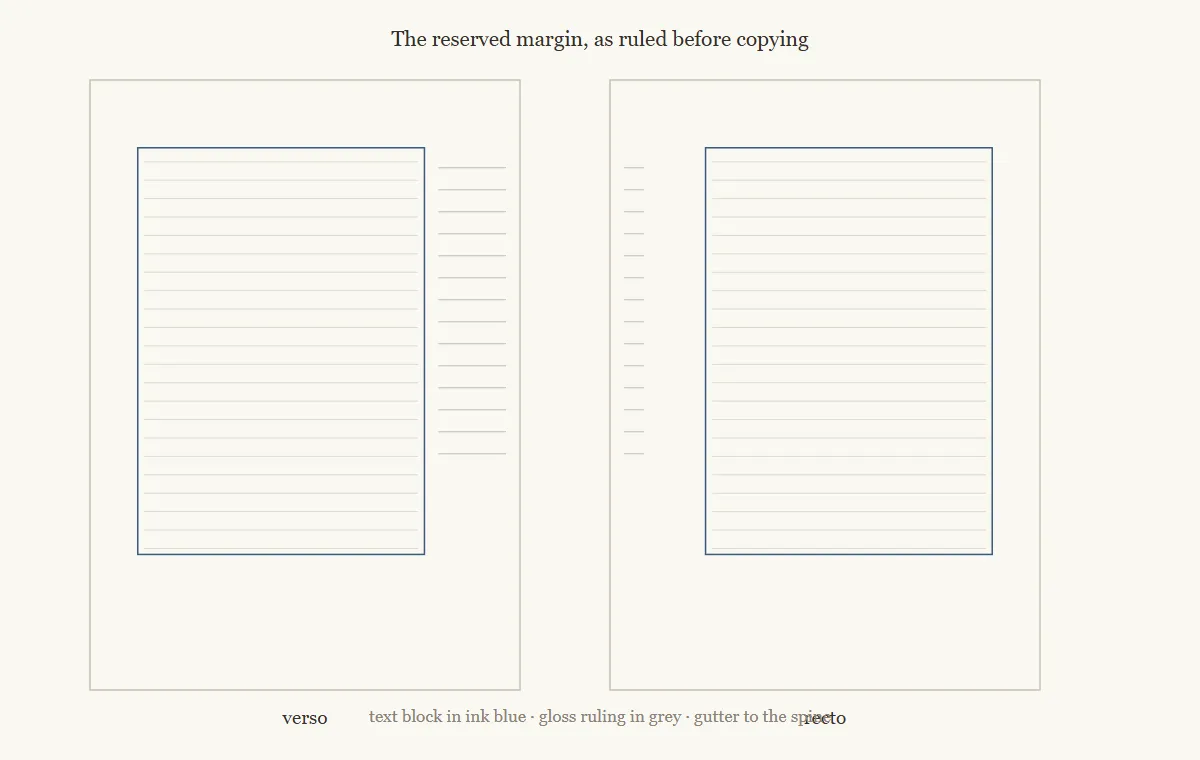
The proportions were not casual. The text block sits inset toward the spine and low on the leaf, so that when the book is bound and the fore-edge trimmed, the block appears optically centred to a reader looking at an open spread rather than a single page. Van de Graaf’s canon and the various reconstructions of it are attempts to recover the geometry after the fact; none of them is a scribal manual, and the neatness of the diagrams flatters the practice considerably. But the underlying point stands. The empty part of the page was not left over. It was allocated.
What went into it varied enormously. Legal manuscripts carried a formal apparatus of commentary, often by named authorities, set in a smaller hand and arranged around the text in a fixed configuration that a trained reader could navigate the way one navigates a familiar form. Devotional books carried the reader’s own accumulation: cross-references, corrections, the date they had read a passage and what they had thought about it. Scholastic manuscripts carried argument, sometimes furious argument, conducted between people who had never met and were often centuries apart.
The economics of this are worth being precise about, because they explain everything that happened next. A manuscript gloss cost nothing but time — the scribe’s time, or the reader’s own. The vellum had already been bought and ruled. Adding a note to the margin of a book you owned consumed no material that was not already committed. The marginal cost of annotation, in the literal sense, was approximately zero, and the page was designed on that assumption.
What print took away
Print did not reduce the appetite for annotation. It changed its price.
A printed marginal note has to be set in type. That means a compositor working in a smaller size, imposing two text streams on one forme, holding them in register through the press run, and correcting both when either is wrong. It is slow, it is error-prone, and — the part that mattered most — it consumes paper, which was the single largest cost in producing an early printed book, frequently more than half of it.
Once annotation had a price, it started to be economised. The sequence is very legible in surviving books, and it runs in one direction for four hundred years:
- The marginal note shrinks. It goes down a size, then two, then to a hand so small that the reader needs good light.
- It gets abbreviated, then reduced to a bare cross-reference, then to a symbol.
- It moves to the foot of the page, where it needs only one column and no register with anything.
- It moves to the end of the chapter.
- It moves to the back of the volume, where it can be set in a single run on the cheapest paper in the book.
Each move is individually defensible. Together they took the note from beside the sentence to a hundred pages away, and nobody along the way was making a decision about reading. They were making decisions about paper.
There is a temptation to tell this as a story of decline, which would be wrong. Much of what filled medieval margins was noise: repetition, piety, score-settling, and long stretches of commentary on commentary that even sympathetic modern scholarship struggles to defend. The eighteenth and nineteenth centuries did not merely banish the note; they disciplined it. The modern convention — argument in the text, evidence and hedging beneath it, apparatus at the back — is a genuine improvement in intellectual honesty over a page where everything competes at once.
The problem is that the disciplining and the banishing arrived together, and only one of them was necessary.
The long exile
By the late nineteenth century the endnote was settled practice in scholarly publishing, and the arguments given for it had detached entirely from the paper costs that produced it. Editors defended endnotes on the grounds that footnotes were distracting, that they broke the page, that they encouraged authors to pad. Some of this is true. None of it is why the endnote exists.
It is possible to be reasonably quantitative about the migration, at least impressionistically, by sampling how much annotation in a given period sat in each position:
| Setting | Year | Measure (mm) | Notes per page | In margin |
|---|---|---|---|---|
| Ruled manuscript leaf | 1250 | 96 | 14 | 92% |
| Early printed quarto | 1495 | 108 | 9 | 74% |
| Scholarly folio | 1580 | 124 | 7 | 38% |
| Octavo edition | 1720 | 96 | 5 | 12% |
| Scholarly octavo | 1890 | 84 | 4 | 3% |
| Academic monograph | 1975 | 108 | 3 | 0% |
| This page | 2026 | 148 | 2 | 100% |
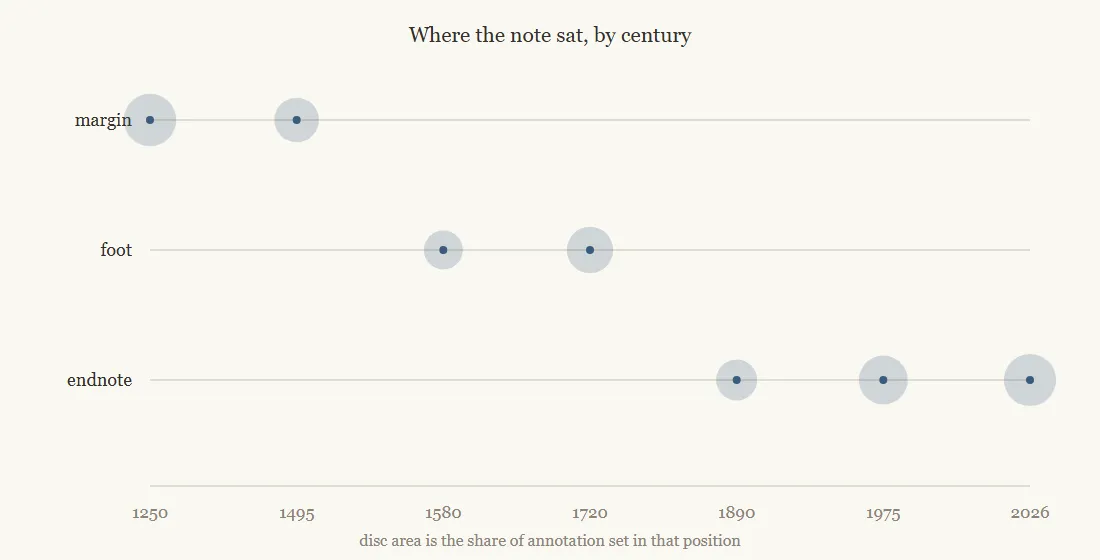
The middle of that table is the interesting part. The seventeenth century is where the margin stops being the default and becomes a choice, and the books that keep marginal notes after about 1650 tend to be the expensive ones — bibles, legal texts, editions where the apparatus is the product. Marginal annotation becomes a luxury good, and then a historical curiosity, and then something a designer has to be talked into.
Meanwhile the reader’s own annotation went the same way, for the same reason. A printed book with generous margins invites writing in it. A book set to the edge of the paper does not. The interleaved edition — blank leaves bound between printed ones, specifically so the owner could annotate — survived into the nineteenth century as a specialist product and then disappeared. The modern paperback is, among other things, a machine for preventing you from having thoughts on the page.
The endnote changes the argument
Here is the part that is easy to miss, and that matters more than the inconvenience.
The position of the note changes what the sentence above it is allowed to assume. This is not a subtle literary effect; it is a straightforward consequence of what the writer expects the reader to have in front of them.
A writer setting a note in the margin knows the reader will see it. The note is therefore load-bearing: it can carry the qualification, the counter-example, the admission that the evidence is thinner than the claim. The sentence above it can be stated cleanly, even boldly, because the hedge is right there, in view, doing its work. The reader gets a strong claim and its limits simultaneously, which is close to how careful thinking actually feels.
A writer setting a note at the back of the volume knows the reader will not see it. Two things follow, and both are bad. Either the hedge migrates up into the sentence, which is how academic prose acquired its characteristic texture of qualification piled on qualification until the claim has been sanded down to something nobody could disagree with and nobody would bother to. Or the hedge stays in the note and is functionally abandoned — present for the record, invisible in practice, so that the text asserts more than the author actually believes and the disclaimer sits a hundred pages away where it satisfies a referee and no reader.
Neither of these is a writing problem. Both are page-layout problems that have been mistaken for writing problems for so long that we teach them as style.
You can watch the mechanism operate in a single author across a career. A scholar’s early articles, published in journals that set footnotes at the foot of the page, tend to make sharper claims with the objections visible below. The same scholar’s later monograph, endnoted by house style, tends toward prose that hedges inline and carries an apparatus at the back that almost nobody has read. The argument did not get more cautious. The notes got further away.
The apparatus as argument
It is worth separating two things that the word “note” is doing at once, because they have different histories and different fates.
The first is the citation: a pointer to where a claim came from. This is the part of the apparatus that modern scholarship has developed to an extraordinary degree of refinement, and it genuinely works better at the back of the book than beside the sentence. A reader following a citation is doing something deliberate — checking, extending, disputing — and has accepted the cost of the trip. Nobody wants a bibliographic string in the margin of every third line, and the periods that tried it produced pages that are difficult to look at and harder to read.
The second is the aside: a qualification, a counter-example, an admission, a piece of context the reader needs in order to weigh the sentence properly. This is not a pointer. It is content, and it is content that the sentence above it depends on.
Print collapsed the two into a single mechanism, because both were solved by the same typographic move — small type, keyed by a number, set somewhere cheaper. Once they shared a mechanism, they shared a fate, and the aside went to the back of the book on the strength of an argument that was only ever true of the citation.
You can see the collapse happening in the seventeenth and eighteenth centuries, and you can see the cost of it in the way scientific prose developed afterwards. A paper that cannot put its caveats where they will be read has two options: state them in the sentence, or state them somewhere they will not be read. The first produces the characteristic density of the modern research article; the second produces the “limitations” paragraph, a form whose whole function is to have been written.
The distinction survives in one place, oddly: the legal apparatus. A statute with marginal notes, or a contract with definitions set beside the clauses that use them, still exists, because in law the consequence of a reader missing a qualification is immediate and expensive. Where being misunderstood has a price, the note stays where it can be seen. Everywhere else it drifted.
That suggests a fairly simple test for any given note, and it is the one I now try to apply while writing rather than afterwards. Ask what happens if the reader does not read it. If the answer is “they cannot check my source”, it is a citation and belongs in the apparatus. If the answer is “they will believe something I do not believe”, it is an aside, and it belongs beside the sentence — or, failing that, inside it. What it does not belong in is a numbered list a hundred pages away, which is where five centuries of paper economics will put it if nobody intervenes.
Reading as a trace
There is a second casualty of the vanishing margin, and it is not the writer’s note but the reader’s.
A book with room to write in accumulates a record of having been read. Not a particularly dignified record — most marginalia is banal, and a great deal of it is simply wrong — but a record, and one that survives the reader. The history of ideas leans heavily on this. We know what a good many people thought about a good many books because they wrote it in the only place available, which was the page in front of them, and because the page was designed to permit it.
The interesting thing about marginalia as evidence is how much of it is not commentary at all. It is navigation: a bracket beside a passage, a pointing hand, a word repeated in the margin so the eye can find the paragraph again on a re-read. A medieval or early modern reader was building an index by hand, in the margin, because the book did not come with one. That labour is invisible to us now because we get the index for free, and we have consequently lost the habit of leaving a trace of our own route through a text.
What replaced it is worse than nothing, because it looks like a solution. The highlight — on paper or on a screen — is a mark that records that something mattered without recording why, and it is almost useless a year later. A margin note that says “but cf. the 1840 figures” is a thought. A yellow stripe is the memory of having had one.
Digital reading could be extremely good at this, and mostly is not, for a reason that has nothing to do with technology: the reader does not own the page. Annotation lives in an application, keyed to an edition, exportable in a format nobody reads, and it does not travel with the text. The medieval reader’s notes were in the same physical object as the words they were about, permanently, which turns out to be the whole of what made them useful.
This site does not solve that, and I am not sure a website can — a reader cannot write in a page they do not hold. But it does at least stop pretending that the margin is decorative. If the space beside the text is where thinking happened for most of the history of reading, a design that fills it with nothing is making a claim about reading, whether or not it means to.
What the screen could do
A window has no gutter cost. Nothing is being trimmed, nothing is being bound, no paper is being bought by the ream, and the space to the right of a column of text is free in a way it has never been free in the history of the book.
So the obvious thing to do — the thing that five hundred years of paper economics prevented and that now costs nothing — is to put the note back beside the sentence.
The dominant convention online does not do this. It does something worse than the printed endnote: a superscript number that scrolls you to the bottom of a page whose length you cannot see, with a small arrow to scroll you back, on a device where your place in the text is not held by your thumb.
There are honourable exceptions, and they have been around long enough that the technique cannot be called experimental. What they share is a recognition that the margin is not decoration — it is the only place a note can sit and still be read involuntarily.
The note that must be hunted is a note that will not be read. The note that sits beside the sentence it qualifies is read almost involuntarily, and it therefore changes what the sentence is allowed to assume.
The involuntary part is the whole of it. A reader who decides to consult a note has already paid a cost, and will pay it perhaps twice in an essay before beginning to ration. A reader whose eye simply falls on the note pays nothing, and reads all twelve.
Objections
Three objections are usually raised, and two of them are serious.
The first is that margin notes are technically fragile. They have to align with the sentence that summons them, they must not collide with one another, and they must survive a reader who narrows the window, changes the type size, or sends the page to a printer. This is true, and it is the reason the technique is rarer than it should be. It is also solved, and solved without script: notes float out of the measure into the margin, and the float algorithm’s own rules mean a later note cannot rise above an earlier one. The layout is correct before any JavaScript runs, and correct if none ever does.
The second is that narrow screens have no margin, which is simply a fact. The honest response is to degrade rather than to pretend: below the width at which a margin exists, the note opens in place, next to the paragraph that referenced it, in response to a tap. It is not as good as the margin. It is considerably better than a scroll to the bottom of the document, because the reader’s position is preserved.
The third objection is that marginal notes look busy, and this one I think is mostly wrong. A page with notes in the margin looks busier in a screenshot and reads quieter in practice, because the alternative to a visible note is not silence — it is the same material forced up into the sentence, where it slows every reader rather than the few who wanted the qualification. Busy-looking and fatiguing are not the same property. The densest-looking page in this essay is the manuscript leaf, and its reader had a better time than the reader of the 1890 octavo.
A working discipline
What comes out of this, for anyone writing rather than studying the history, is fairly short.
Write the note where the reader will see it, and then let the sentence above it be as strong as you actually believe. If the qualification has to be read for the claim to be honest, the qualification cannot live a hundred pages away; either bring it into view or bring it into the sentence, but do not pretend that a note at the back has done the work of one at the side.
Watch for hedges that have crept inline. They are usually notes that lost their home. A sentence carrying three subordinate clauses of qualification is frequently a sentence with three abandoned margin notes in it, and pulling them back out is one of the more reliable ways to make prose both bolder and more accurate at once.
And be suspicious of any apparatus you would not read yourself. If you would not follow your own endnote, you have not written a note. You have written a receipt.
Finally — and this is the part that took me longest to accept — be willing to cut a note rather than relocate it. A great deal of what ends up in an apparatus is there because the writer could not bring themselves to delete it and could not find anywhere in the argument it belonged. The margin is not a solution to that. Putting a note where it will be read is only an improvement if the note deserves to be read, and the discipline of writing for a visible margin turns out to be, more than anything else, a discipline of having fewer notes and meaning them.
Twelve notes in four thousand words is close to the upper limit of what a reader will absorb without resentment. The manuscript leaf managed fourteen on a single page, but its reader had been trained on nothing else, and had rather fewer books to get through.
This is a sample piece included so every layout path in the site is exercised —
long-form length, a table of contents, twelve sidenotes including adjacent and
multi-paragraph ones, two figures, a table, an epigraph and a section divider. Delete
the files beginning sample- when you no longer need them.
Notes
-
The proportion varies enormously by kind of book and by workshop. A third of the leaf is typical of glossed legal and scriptural manuscripts; devotional books reserve much less, and some working copies reserve almost nothing. ↩
-
Tschichold’s account is a reconstruction, inferred from measurements of surviving books rather than copied from any surviving instruction. It describes the practice plausibly and should not be read as documenting it. ↩
-
The gloss on a heavily commented manuscript is frequently a conversation across several hundred years, in several hands, with the later contributors disagreeing with the earlier ones in the same physical space. It is the nearest thing the period had to a thread. ↩
-
Paper accounted for somewhere between a third and two-thirds of the production cost of a fifteenth-century printed book, depending on format and print run. It is the dominant variable in every surviving costing. ↩
-
This is the part that seems to me most worth holding onto. No one decided that readers would be better served by notes at the back. The decision that was actually made, repeatedly, was that paper was expensive. ↩
-
The persistence of marginal apparatus in bibles and legal texts is instructive: both are books where the reader is expected to consult rather than read through, and where the apparatus is a substantial part of what is being sold. ↩
-
Interleaved editions were produced for naturalists, lawyers and clergy — professions where the reader’s own accumulated notes were expected to outlast the edition. Their disappearance tracks the point at which books became cheap enough to replace rather than annotate. ↩
-
I am describing a tendency, not a law, and I have no systematic evidence for it beyond a fairly wide reading habit and the experience of writing both ways.
What I am confident of is the mechanism: an author’s sense of what the reader has in front of them is not a minor influence on their sentences. It is close to the dominant one. ↩
-
The confound here is obvious — early-career articles and late-career monographs differ in far more than note placement. I offer the pattern as something to notice, not as a finding. ↩
-
Anchor navigation on a long page is unusually hostile on a phone: the scroll position is not held, the back gesture is ambiguous, and the return arrow is a small target inside a dense list. ↩
-
The mechanism is
float: rightwithclear: rightand a negative right margin equal to the note’s own width plus the gutter. The negative margin lifts the note wholly outside the measure, so it displaces no text;clear: rightforbids a later note from rising above an earlier one, so collisions resolve downward. ↩ -
This matters more than it sounds. A layout that is correct only after script has measured it is a layout that flickers on every slow connection and breaks on every fast one that fails. ↩